Unlocking Rural Value: A Feasibility Case Study
Author: David Campbell BA BArch MA PgDIP RIBA
Estimated reading time: 4 minutes
Rural development in the green belt looks intimidating until you understand the planning toolkit available. This feasibility case study shows how strategic thinking at the earliest stage can transform a farmhouse and its agricultural outbuildings into a rural retreat — unlocking value that conventional planning routes would never reach.
The Hidden Architecture of Rural Planning
Most landowners approach a rural site assuming the only path forward is a full planning application, with all the time, cost, and risk that brings. The General Permitted Development Order offers a more sophisticated set of tools.
Class Q: Allows agricultural buildings to be converted to residential use, with comprehensive external alteration rights including windows, doors, roof works, and a single-storey rear extension of up to four metres. Up to ten dwellings, 1,000 square metres total per agricultural unit.
Class R: Significantly expanded in May 2024, allowing agricultural buildings to be converted to a flexible range of commercial uses including hotels, cafés, offices, retail, sport and recreation, across up to 1,000 square metres per agricultural unit.
Full planning applications: Required for external alterations under Class R, for new build elements, and where the design ambition extends beyond permitted development scope. Strong policy support exists for rural enterprise and agricultural building re-use.
Used in combination, these provisions can unlock substantial development potential without entering a contested planning process. The difficulty is that the rules are technical, layered, and were materially amended in 2024, and the strategic implications are easily missed without close familiarity with the legislation and its practical application.
Expertise as the Multiplier
What separates a successful rural feasibility from a stalled one is rarely the quality of the buildings or the ambition of the brief. It is the quality of the strategic thinking applied at the outset.
Sequencing: Understanding how Class Q rights interact with Class R rights, and how to sequence them across a phased delivery.
Credibility building: Using permitted development to establish operational credibility before pursuing more contested full applications.
Technical fluency: Navigating prior approval requirements, transitional arrangements, and the specific eligibility criteria that have shifted under recent amendments.
It is the difference between treating planning as a hurdle and treating it as a design tool.
A Feasibility Built Around Strategic Layering
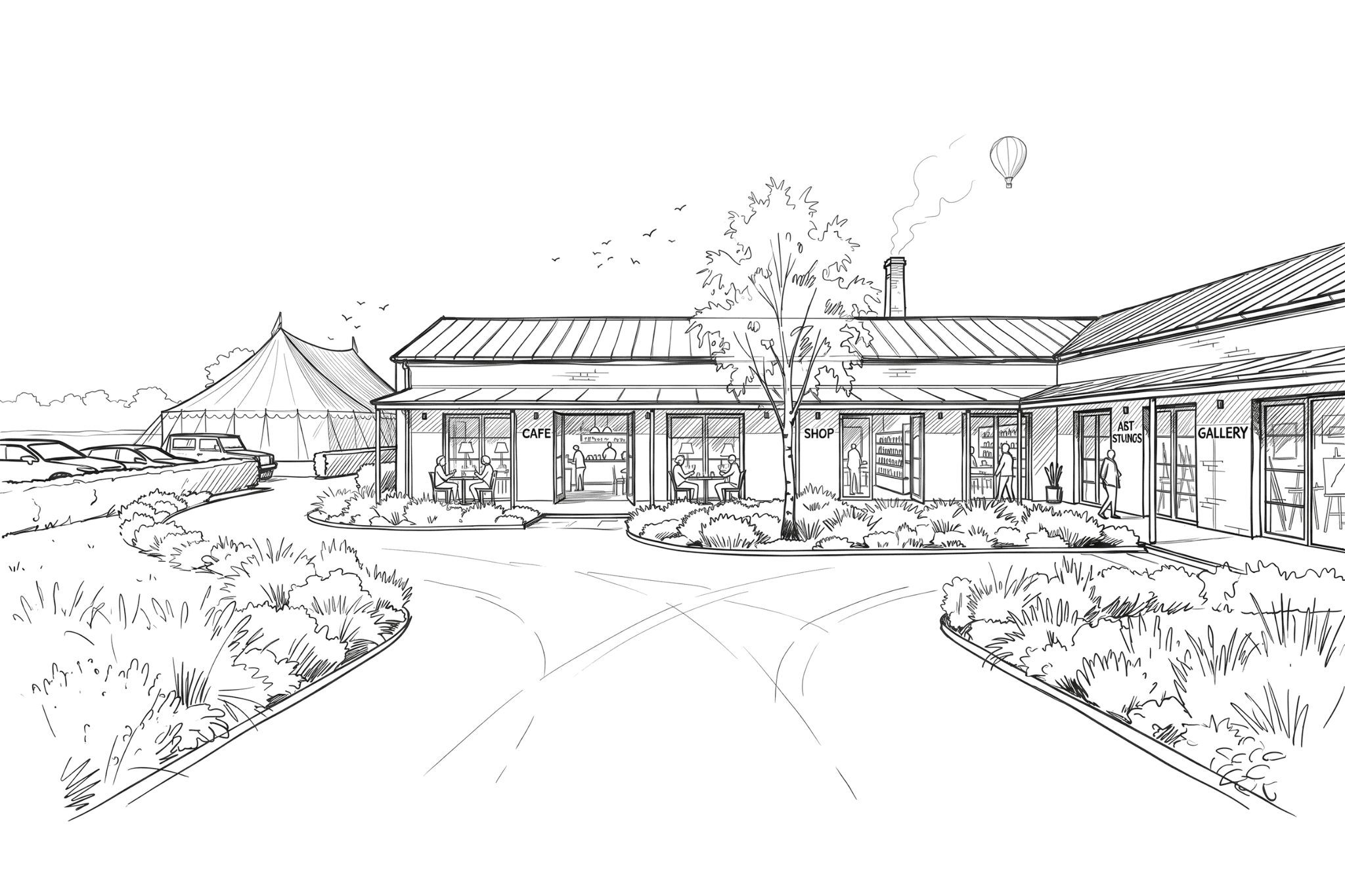
The site comprises a traditional farmhouse, a modern agricultural barn with an existing Class Q consent for four residential units, two stable blocks, and an ancillary office building, set within twelve acres of agricultural land in the West Midlands green belt. Rather than presenting a single development scheme, we modelled five distinct pathways:
Full Residential Hamlet: £1.85m investment, twelve residential units delivered through Class Q rights.
Hybrid Hamlet: £2.2m investment, mixed Class Q and Class R, eight keys plus café, spa, and retail.
Boutique Hotel Estate: £3.15m investment, eleven keys with restaurant and spa facilities.
Wedding and Events Estate: £2.65m investment, seven keys with events capacity for 150 guests.
Eco-Retreat and Expansion: £5.30m phased investment, twenty-seven keys and a comprehensive event and retreat expansion.
Each pathway maps a different combination of planning routes against a different commercial strategy, allowing the client to select an investment profile that matches their risk appetite, capital position, and operational ambition.
Risk Managed, Not Avoided
Strategic phasing is the discipline that turns a planning opportunity into a viable business. The recommended pathway begins with the implementation of the existing Class Q consent on the modern barn, establishing an operational baseline within eighteen months. Further Class Q and Class R conversions follow across the remaining outbuildings, expanding capacity without full application risk. Only once operational credibility is established does the strategy move to full planning applications for new build elements such as eco-lodges, a dedicated spa pavilion, and event facilities.
This sequencing is deliberate. It builds a track record with the local planning authority, generates revenue to support subsequent phases, and allows the development to respond to market conditions rather than commit to a single fixed scheme. Risk is not eliminated, but it is structured, sequenced, and managed.
The Value V+D Brings at Feasibility Stage
A well-prepared feasibility is not simply a planning document. It is a strategic instrument that allows the client to make informed decisions about capital deployment, market positioning, and delivery timeline before committing to a single scheme. The work draws together:
Planning analysis: Detailed appraisal of permitted development rights, full application routes, and policy support.
Legal and title review: Restrictive covenants, overage clauses, and agricultural use verification requirements flagged at the outset.
Precedent analysis: Comparable rural hospitality projects including Soho Farmhouse, The Pig, Green Farm Kent, The Mount Barns, and Elmley Nature Reserve, benchmarked for scale, investment, and operational model.
Development cost modelling: Conversion, extension, new build, and infrastructure costs benchmarked against current construction rates.
Revenue projection: Sales values, RevPAR, spa and F&B revenue modelled against regional market data.
Phased delivery strategy: Sequenced investment aligned with planning risk and operational ramp-up.
We treat feasibility as a problem of strategy as much as design. The principle holds whether the brief is a single barn conversion or a 27-key rural retreat. Understand the planning framework, design the strategy, then design the buildings.
Considering a rural development project? Contact Vision + Design to discover how feasibility-stage strategy can shape the success of your scheme.
→ Email us at info@visionanddesign.co.uk
→ Or call us on 07931910243